

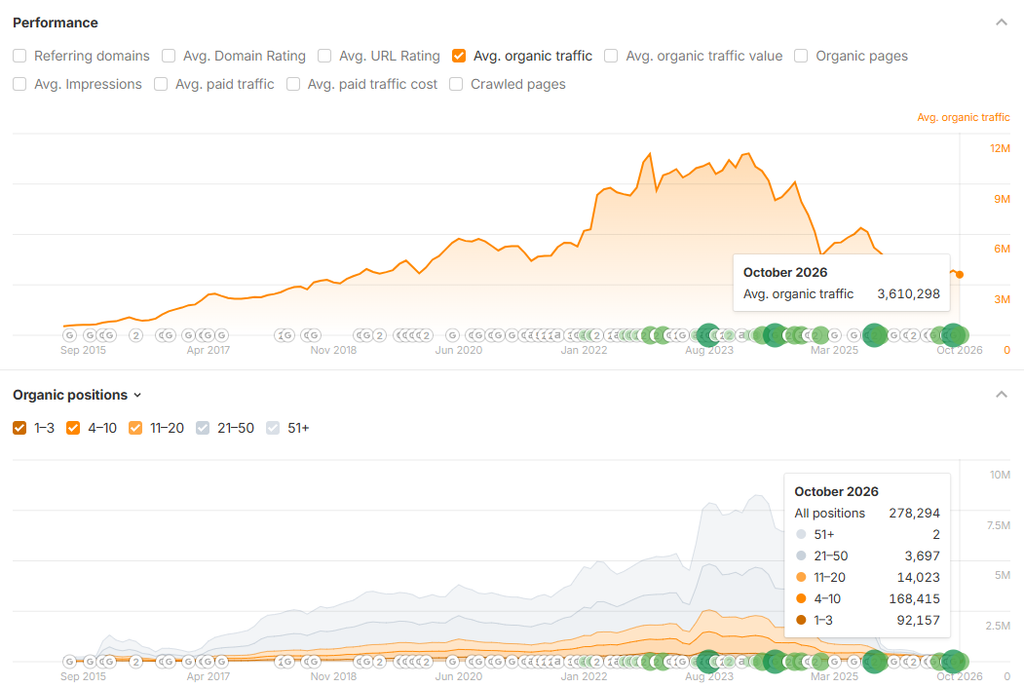
It’s October 2026. Ahrefs estimates HubSpot’s organic traffic at ≈3.6 million visits, down roughly −689K month on month. The platform also places the site far below its 2023 and early-2024 peak of almost 11 million visits. The number is a third-party estimate, not HubSpot reporting, but similar platforms point in the same direction: HubSpot’s organic traffic isn’t what it used to be.
Some would say that this is completely natural, since “SEO is dead.” But is that true?
HubSpot remains a powerful company with a powerful brand, they’ll be fine. But the model it taught B2B software companies to copy – publish answers to every informational question and let traffic compound into demand – depended on conditions that search no longer supplies for free.
What does the data tell us about HubSpot’s current SEO standing?
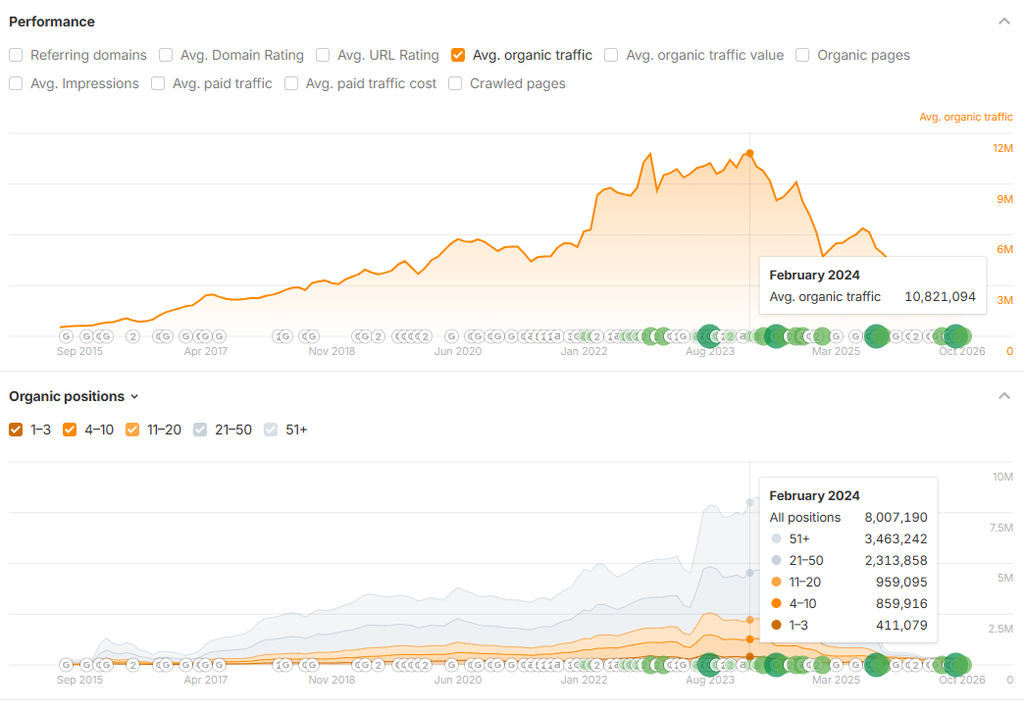
Back at its traffic peak, in February 2024, HubSpot ranked for over 8 million keywords. Most of these keywords were in very low positions, with over 2 million keywords in positions 21-50 and almost 3.5 million beyond position 51.
Fast-forward to the present day and HubSpot is only ranking for 278,294 keywords, with only two organic positions beyond spot 51.
HubSpot is the brand that defined and launched the concept of inbound marketing. They’re a category-shaping leader within the highly concentrated CRM market. But, even with those factors in mind, 8 million keywords is a bit too much.
Are there 8 million inbound-marketing and CRM related keywords that HubSpot fought to dominate, or was there something else going on?
HubSpot’s inbound bargain
If we filter out branded keywords, we’ll find that some of HubSpot’s organic traffic comes from keywords that have nothing to do with their product – "excel online" brings over 206,000 visitors per month, while "how to use instagram" brings over 209,000.
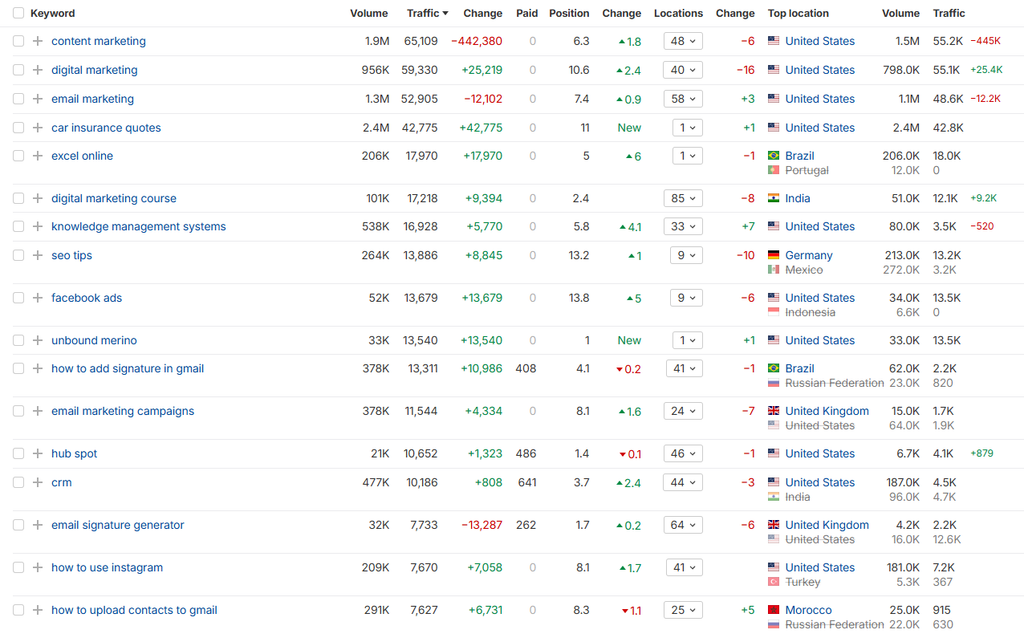
The SEO playbook that HubSpot relied on aimed towards volume rather than product-content fit. Generic, tech-related keywords were perceived as free real estate to cover for awareness purposes. The query "car insurance quotes" doesn’t suggest intent to buy a CRM subscription.
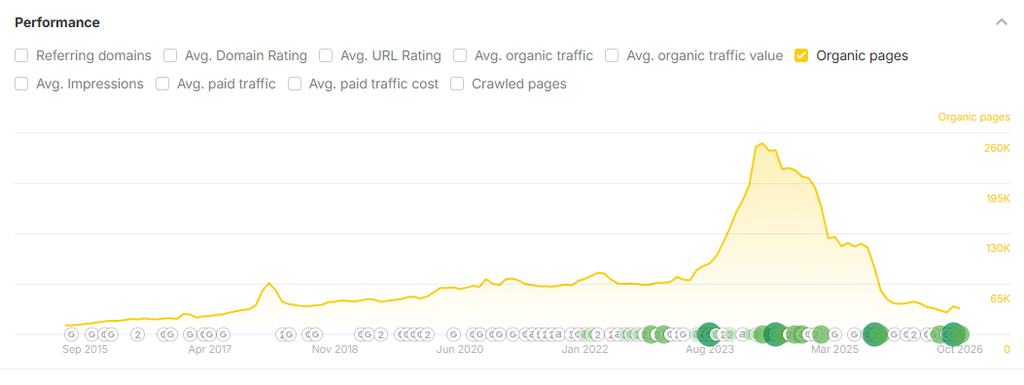
The peak in HubSpot’s organic traffic coincides with their peak in organic pages. Since then, the website has experienced a reduction in content volume. Could it be that HubSpot is cleaning up their enormous content library and focusing on its strongest content? Was HubSpot’s problem a large volume of off-topic content?
The content-led growth playbook requires that we make certain assumptions – do they still stand in 2026?
Let’s run with that hypothesis for a while: Content-led growth worked because a company could turn broad informational demand into an owned audience. That bargain relied on four conditions:
| Condition | What it supplied | What is changing |
|---|---|---|
| Click surplus | A ranking produced a visit | Answer layers, richer results and AI interfaces increasingly absorb “what is” & “how to” questions |
| Authority transfer | A strong domain could publish broadly | High authority now coexists with less traffic – HubSpot has a DR of 93/100, and it’s still bleeding traffic |
| Scope tolerance | Search rewarded volume outside the core product | Broad, lightly related libraries face higher quality and relevance pressure |
| Attribution forgiveness | Sessions could stand in for commercial impact | Brand, qualified demand and pipeline now tell a different story from raw traffic |
We can see the same trends across certain pockets of the media ecosystem, with publications increasingly relying on video + social traffic, while losing big on the SERPs. Of course, there are exceptions – both the New York Times and the Wall Street Journal are enjoying growing organic traffic (albeit with fewer keywords).
So, back to HubSpot – this hypothesis outlines a very clear story: Concentrated content, and fewer pieces with true market fit outperform spread-out, generalist content. Great!
So, remember that “car insurance quote” example we brought up when discussing HubSpot’s questionable SEO practices? We’ve got something awkward to tell you…
What’s the impact of the HubSpot SEO playbook?
We tracked down which page HubSpot’s using to rank for "car insurance quotes". It has nothing to do with car insurance. It’s a very technical and valuable guide on how to create quotes on HubSpot’s legacy quote creator. We checked its backlink history and noticed that it’s a permanent redirect from a different URL. Ha! Maybe the old content was full of off-topic advice about car insurance quotes.
Mmm, no. The old guide was very similar to its successor and it had nothing to do with car insurance. The terms “car” and “car insurance” are fully absent from the content and its metadata. So, what’s going on?!
HubSpot’s knowledge base article on configuring legacy quotes (/quotes/set-up-legacy-quotes) ranking for "car insurance quotes" provides a fascinating case study in how modern search engines process semantic signals across large domains. While the documentation page itself contains standard B2B software setup instructions for e-signatures and pricing settings, the root cause of this ranking stems from user-generated content on community.hubspot.com. There, a forum thread specifically asked how to automate quote calculations for a car insurance company, explicitly tying the concepts of “car insurance,” “quotes,” and “HubSpot” together on the domain.
Modern search engine algorithms rely heavily on dense retrieval and vector embeddings to group related concepts, mapping connections across an entire site rather than evaluating pages in total isolation. By combining the entity signals from the user-generated community forum with the structural authority of the official documentation page, Google’s semantic models created a conceptual bridge between “car insurance” and HubSpot’s native quoting tool. Paired with HubSpot’s immense domain authority, the algorithm over-generalized these semantic signals, leading Google to mistakenly surface a technical software setup guide for a high-volume consumer auto insurance query.
What does this mean?
This specific anomaly is an accidental microcosm of the exact mechanism that triggered HubSpot’s broader SEO collapse.
HubSpot’s long-standing organic playbook relied on building massive domain authority and casting an extremely wide net, publishing thousands of top-of-funnel articles on generic subjects to capture maximum web traffic and funnel those visitors toward their CRM products.
This “car insurance” example directly illustrates how that “wide rather than deep” strategy backfired. This is happenning because Google doesn’t really understand the HubSpot website’s scope.
The useful distinction is between reach and demand
For years, ranking for tangentially related terms was considered a free win. But as search engines transitioned from keyword matching to strict topical boundaries, those fringe rankings went from being free brand awareness to actively poisoning the domain’s topical focus.
The old playbook collapsed two different jobs into one metric. A post could reach a huge audience and still create little demand for the product. That ambiguity was tolerable while search delivered cheap clicks at scale. But as organic traffic dries up and budgets tighten, SEOs are starting to say the quiet part out loud: This type of strategy was always an awareness play with very weak ties to conversion.
HubSpot will survive. Beyond their SERP presence, they’re backed by years of narrative capital. HubSpot’s best keywords are branded, and a user searching for “HubSpot pricing” or “HubSpot Academy” has already crossed a threshold that a generic “what is CRM?” visitor may never cross. The company can build from that advantage. Smaller companies that copied the publishing model usually cannot.
New times demand new models.
AI citation is not a rescue plan, welcome to the zero-click era
We’re in the age of “zero-click searches” – basically, user journeys that begin and end on the Google SERPs, without users ever moving forward to a third-party page. With AI overviews, Google covers most informational queries, capturing traffic that, before this feature, would have gone to publishers.
This is one of the main reasons why so many websites are losing traffic, HubSpot included. Not only was HubSpot’s content unrelated to its product, it was also far too generic and TOFU (top-of-funnel). Let’s take a look at a concrete example:
Recently, HubSpot lost their positioning for the keyword "what is a target audience".
Back in the day, an article titled “What is a Target Audience?” was amazing for attracting curious users who would be taken on a learning journey by HubSpot. The amazing value provided by the article would create a positive association in the user’s mind: HubSpot is where quality marketing info’s at. And this user would be a click away from discovering the product, signing up for a free trial, converting… they may not do it today, but eventually, when they need a CRM, they may remember that HubSpot taught them what a target audience was.
That’s what the same experience looks like today:
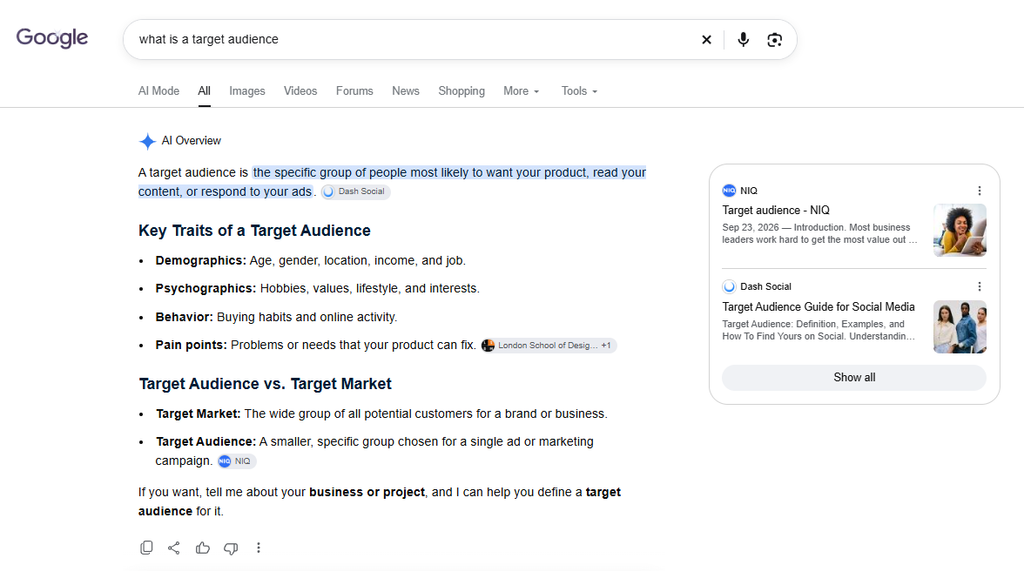
The user searches “what is a target audience” and receives an AI Overview, at the top of the SERPs, providing them with all the information they need to know.
Are you in a HubSpot SEO-like situation? Here’s what to do
1. Audit and clean up your content library
If your company is in HubSpot’s SEO situation – that is, with an inflated and exceedingly diverse content library, audit your website and delete all off-topic content. Organize the remaining content into topical clusters.
Concentrate on bringing traffic to a couple of pieces with high content-product fit. In fact, you may find that your best pieces may be long due for an update.
That’s a great start, but it’s far from enough. What should you do about the AI Overviews’ intercession between your users and your brand?
2. Move TOFU out of SEO
If a user’s not asking Google, they’re probably asking ChatGPT or Claude. Of course, you can always get ranked as a reference within AI search, and AI can bring you real traffic and customers.
But, to keep the ROI of every piece as high as possible, move your long-form written content down the funnel. Your SEO TOFU motion is being sabotaged by AI, so move TOFU to social and use our long-form content for MOFU and BOFU. Make sure you’re covering long-string keywords that suggest high purchasing intent: Your product comparisons and product-centric tutorials. Want to keep some TOFU content on your website? Create brand-building, storytelling content and distribute it on social.
3. Set up clear guardrails to prevent topical dillution from happening again
How can you make sure that no new content suffers from low product-content fit?
Before approving an idea, run it through this checklist:
[ ] Product adjacency
Can you name the feature, workflow or customer problem this page serves in one sentence? If the connection seems too convoluted or implausible, drop it.
[ ] Unfair evidence
Does the company have something a generic publisher cannot get: customer data, product access, benchmark results, support logs, practitioners willing to be quoted? If not, the page competes on effort alone, which is the part of the market answer engines now supply for free.
[ ] Audience overlap
Estimate what share of the query’s searchers could realistically become customers. A small number is acceptable for a brand play; it is not acceptable as the default assumption.
[ ] Post-answer value
If an AI summary satisfied the query, what would the visitor still want from the page? Calculators, templates, comparisons, pricing detail and screenshots survive summarization. Definitions and listicles do not.
[ ] Path to demand
State the next step after the visit – trial, demo, docs, comparison, newsletter – and where it appears on the page. No plausible next step means the page is a destination, not part of a funnel.
[ ] Cluster membership
Which existing topic cluster does it extend? A page that maps to no cluster and no commercial topic creates an island, and islands are what get pruned first.
[ ] Metric and review date
Name the metric that will judge the page in 90 days and the date someone will look at it. Sessions alone disqualify the page.
[ ] Named owner
Every page gets a person responsible for refreshing, consolidating or retiring it. Orphaned content is how the long tail fills with pages nobody defends.
Frequently asked questions
Is HubSpot’s traffic decline proof that SEO no longer works?
No. The evidence supports a more precise conclusion: informational rankings do not guarantee clicks or commercial value. Search still matters where intent, product fit and page type align.
Should companies stop publishing informational content?
No. They should stop treating volume as a strategy. Publish when the company has distinctive evidence, expertise or utility to add, and measure the effect on demand rather than sessions alone.
What should replace traffic as the main content metric?
Use a mix of branded search, qualified pipeline influence, commercial-page engagement, conversion by entry point and retention of the audience you own. The right mix depends on the buying motion.

By Aaron Marco Arias